 Activities
 Elsewhere Online
Links
Elsewhere Online
Links

The Chelmsford Quilt Guild Library
Book Reviews, May 2010
The Ultimate Sashiko Source Book, Susan Briscoe
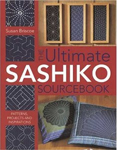 When
I signed up for a Sashiko Sampler Block of the Month class I had no idea what
was ahead of me. I was attracted by the lovely sample with its appealing
indigo and white motifs and the challenge of doing some handwork again. I
did find it challenging, but also relaxing and rewarding. Perhaps this book
will provide you with the same impetus to try something new.
When
I signed up for a Sashiko Sampler Block of the Month class I had no idea what
was ahead of me. I was attracted by the lovely sample with its appealing
indigo and white motifs and the challenge of doing some handwork again. I
did find it challenging, but also relaxing and rewarding. Perhaps this book
will provide you with the same impetus to try something new.
I learned many things from this book, beginning on the first page: how to pronounce "sashiko:" "sash(i)ko (the 'i' is nearly silent.)" A fascinating history of sashiko stitching follows. The origins greatly resemble that of traditional patchwork with a strong overlay of Japanese historical and spiritual tradition.
I wished I had read the section on equipment and materials before I started my project, as it would have saved me some trials and errors in marking and choice of wadding (Briscoe's British term for batting). And my finished product would have been nicer if I had read and followed her basic techniques. The clear examples of right and wrong stitching filled me with chagrin!
Finally the projects. Briscoe shows wonderfully creative ways to use small pieces of sashiko stitching to great advantage in framed pictures, greeting cards, coasters, pincushions, and tablemats. Larger pieces become tote bags, cushions, and table runners. Then follows a large section featuring many sashiko stitching designs with tips for stitching them.
The samples in the Inspiration Gallery that rounds out the book will give you pause with their breathtaking beauty and simple complexity. But hopefully they won't intimidate you and you will check out this book and get started on your own sashiko sampler.
—Carlene Craib
The Expert's Guide to Foundation Piecing, Jane Hall
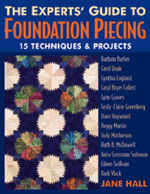 Wouldn't
it be fantastic to be able to go to a workshop where fifteen internationally
known experts on a technique each shared her expertise and favorite tips?
Jane Hall has recruited just such a group to delve into the techniques of
foundation piecing. She first presents a history of the evolution of foundation
piecing from the earliest log cabin designs of the early 19th century in Britain
to the most recent developments in pictorial designs.
Wouldn't
it be fantastic to be able to go to a workshop where fifteen internationally
known experts on a technique each shared her expertise and favorite tips?
Jane Hall has recruited just such a group to delve into the techniques of
foundation piecing. She first presents a history of the evolution of foundation
piecing from the earliest log cabin designs of the early 19th century in Britain
to the most recent developments in pictorial designs.
An overview of basic techniques follows, and then the experts take over. Each one presents complete directions for a project incorporating relevant tips for the particular techniques of her specialty. There is great variety here: traditional designs from Carol Doak's now familiar sharp points in a floral star to Jane Hall's pineapple block and Barbara Barber's ring designs. There are also innovative art quilts designs by Ellen Sullivan and Ruth McDowell.
Another chapter shows folded foundation piecing with three variations, each one building on the other. Chapters on string piecing and single template piecing complete the lessons. I had never grasped how Ruth McDowell achieved her stunning effects until I read this chapter.
The fabulous gallery of quilts at the end will help you decide which might be the technique that matches your quilting style or maybe will inspire you to try something completely out of your particular box. Foundation piecing might be this summer's "new thing" in your quilting repertoire.
—Carlene Craib